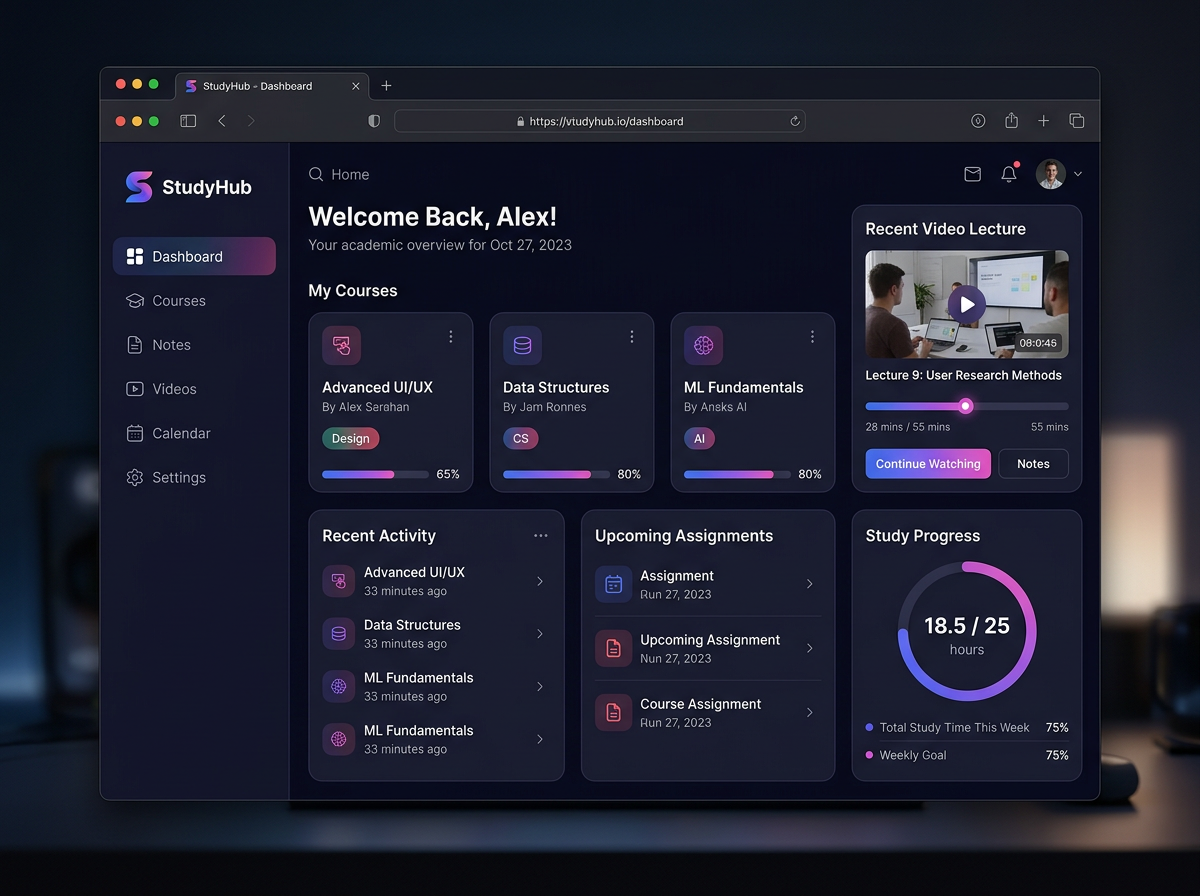
The first time Study Hub failed for a real user, it wasn't a bug in my code — it was the college Wi-Fi dropping mid-session while someone tried to load a video lecture before an exam. That single failure taught me more about good engineering than any tutorial had.
Most of my early projects assumed a stable connection because, frankly, mine usually was stable. But the people actually using these apps — classmates on hostel Wi-Fi, milk vendors in villages with patchy mobile networks — didn't have that luxury. Building for them meant unlearning a lot of assumptions.
Offline isn't a feature, it's a mindset
It's tempting to treat "offline support" as a checkbox — add a service worker, cache a few assets, done. But real offline-first design means asking, at every decision point, "what happens when this request never returns?" That question changes how you structure data, how you handle forms, and how you communicate state to the user.
- Study Hub caches viewed notes and videos automatically, so revisiting material never depends on a live connection.
- Dudh Wala stores every ledger entry locally first, syncing only when a connection happens to be available.
- Both apps show clear, honest status indicators — never a silent failure that leaves the user guessing.
Designing for bad connectivity is really just designing for honesty about what your app can and can't guarantee.
Low-end devices changed my CSS too
Heavy animations and large unoptimised images look great on a development machine and terrible on a three-year-old budget phone. Once I started testing on the actual devices my target users own, I cut animation complexity, compressed every image aggressively, and rebuilt several layouts around simpler CSS that renders fast even on weaker GPUs.
The empathy part
None of this is really about technology. It's about taking seriously the fact that the person using your app might not have what you have — fast internet, a new phone, unlimited data. Offline-first development, done properly, is an exercise in empathy disguised as an engineering pattern.